
WELCOME BONUS 300%
UP TO €2000 + 100
FREE SPINS
UP TO €2000 + 100
FREE SPINS
Home → Blackjack
Blackjack at Wyns: Variants, Rules and Payouts
Clicked Too Late: Hand Is Automatically Held
In certain Blackjack variants, the player's hand is automatically held if an action is attempted after the dealer has already checked for a Blackjack. This rule modification can affect optimal strategy. For instance, in Blackjack 6 Decks, where the dealer stands on Soft 17, attempting to double down or split after this point would be invalid.
This automatic hold feature is a mechanism to ensure fair play and adherence to the game's progression, particularly in live dealer environments. Without this, players might attempt actions that would be impossible once the dealer has initiated the next phase of the round. The consequences for the player are that their intended action is nullified.
Understanding these game-specific rules is crucial for mobile play, where interactions might be quicker. Failing to act within the allowed window can lead to a missed opportunity to improve a hand, such as doubling down on a favourable starting total of 11. This can indirectly increase the house edge if players frequently miss strategic opportunities.
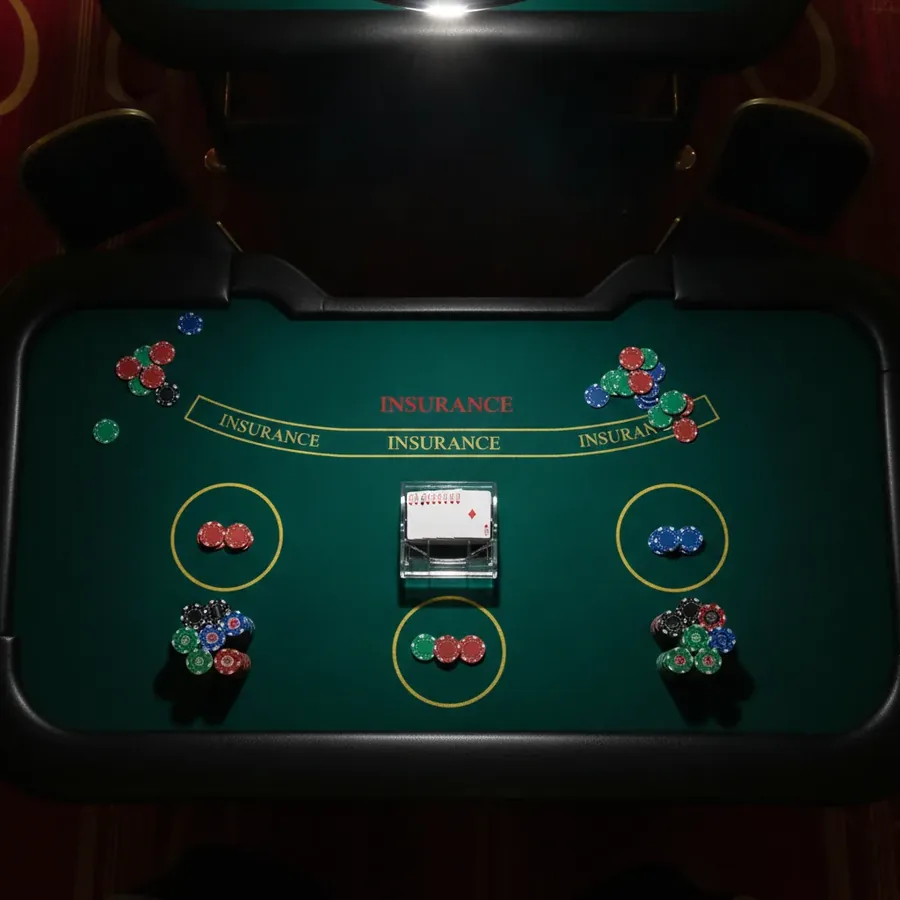
Error insurance: 7 percent additional house edge
Blackjack Insurance, offered when the dealer's upcard is an Ace, functions as a side bet with a significant house edge. This bet pays 2:1 if the dealer has Blackjack. However, for a game using 6 to 8 decks, the RTP is only 92.53%, resulting in a substantial 7.47% house advantage.
The basis strategy dictates that players should always decline this insurance bet, unless employing advanced card counting techniques with a true count of +3 or higher. This recommendation is due to the unfavourable odds presented by the bet itself. Even with a single deck, where the advantage might be around 5.88%, it remains disadvantageous for most players.
Accepting the Blackjack Insurance bet when it is not strategically justified can dramatically increase the overall house edge on a player's session. For example, a player consistently taking insurance in a game with a 7.47% edge would see their expected losses per hand increase substantially compared to a player who always declines.
Side Bets Increase House Edge to 5 Percent
Infinite Blackjack, a live dealer variant, features four side bets: Any Pair, 21+3, Hot 3, and Bust It. While these offer additional betting options, they generally carry a higher house edge than the main game. For instance, a suboptimal side bet could push the total house edge towards 5%.
These side bets are distinct from the core Blackjack game and do not follow the same RTP calculations. While Lightning Blackjack has an RTP of 99.56%, the inclusion of side bets can drastically alter the overall return to player. The complexity and payout structures of these bets often result in a less favourable outcome for the player.
Players engaging with these optional bets should be aware that they are introducing a higher degree of risk into their gameplay. The allure of potentially larger payouts on side bets needs to be weighed against the statistical disadvantage. For maximum return, focusing solely on the main Blackjack game is advisable.
Blackjack Party runs with two hosts
Blackjack Party, provided by Evolution, offers a unique live dealer experience with an engaging atmosphere. This variant is distinguished by the presence of two hosts who manage the game and interact with players. The betting range for this table is from 1.00 to 1,000 EUR.
Unlike standard Blackjack tables, Blackjack Party emphasizes entertainment and social interaction. The hosts create a lively environment, which can be particularly appealing for players who enjoy a more casual and social gaming session. This deviates from the purely technical focus of games like Blackjack 6 Decks.
The inclusion of two hosts in Blackjack Party contributes to its distinct player appeal. While the core Blackjack rules remain, the enhanced entertainment value is a key feature. Players looking for a dynamic and interactive live casino experience might find this variant particularly enjoyable, even if it's not strictly about optimal RTP figures.
Four hours of play with 300 EUR bankroll
A player with a 300 EUR bankroll could potentially sustain approximately four hours of play on a Blackjack table with a 0.15% house edge, assuming an average bet size and a steady number of hands per hour. This assumes a player adheres to strict bankroll management and does not deviate from optimal strategy.
Consider a scenario where a player bets 5 EUR per hand on a Blackjack table with 3:2 payouts and a 0.15% house edge, equivalent to Blackjack Ein Deck, klassische Regeln. Over four hours, at an estimated 100 hands per hour, this would involve 400 hands and a total wagered amount of 2,000 EUR, with an expected loss of 3 EUR.
This extended playtime is achievable through disciplined betting and focusing on games with a low house edge. For instance, choosing Blackjack Liberal Vegas Strip with its 0.28% house advantage would still allow for a considerable duration of play within the same bankroll constraints, demonstrating the impact of favourable rules.
Blackjack variants at a glance
| Variant | Payout | House edge | Rule | Bet range |
|---|---|---|---|---|
| Blackjack Auszahlung 6:5 statt 3:2 (6 Decks) | 98.15% | 1.85% | Ersatz von 3:2 durch 6:5 fügt exakt +1.39 Prozentpunkte zum Vorteil des Casinos hinzu – stärker als jede andere Regeländerung. Bei $10 Einsatz zahlt Blackjack $12 statt $15. | Blackjack 6:5, Gewinn 1:1 |
| Blackjack 6 Decks, S17, DAS, DOA, Auszahlung 3:2, Basisstrategie | 99.54% | 0.46% | Dealer steht auf Soft 17; Verdopplung auf jeder Zweierkarte; Verdopplung nach Split erlaubt; keine Aufgabe. Basisstrategie ist für diesen Wert zwingend | Blackjack 3:2, normaler Gewinn 1:1, Insurance 2:1 |
| Blackjack Ein Deck, klassische Regeln, 3:2 | 99.85% | 0.15% | Weniger Decks = niedrigerer Vorteil; ein Deck gibt ca. −0.48 Prozentpunkte gegenüber 8 Decks. Oft durch 6:5 Auszahlung kompensiert. | Blackjack 3:2, Gewinn 1:1 |
| Blackjack Insurance / Versicherung (6–8 Decks) | 92.53% | 7.47% | Separate Nebenwette bis 50% der Hauptwette, wenn der Dealer ein Ass hat. Basisstrategie schreibt IMMER Ablehnung vor (außer Karten zählen bei True Count ≥ +3). Bei einem Deck Vorteil ≈ 5.88% | Insurance 2:1 |
| Blackjack Surrender (Late Surrender) – Regel-Effekt | n.a. (Regel-Modifikator) | −0.08 Prozentpunkte | Spieler gibt Hand nach Dealer-Blackjack-Prüfung auf, verliert die Hälfte des Einsatzes. Verbessert RTP um ca. 0.08 Prozentpunkte. Early Surrender ist wesentlich wertvoller (bis −0.6 Prozentpunkte), aber extrem selten. | Rückzahlung 50% des Einsatzes |
| Blackjack Liberal Vegas Strip (liberale Regeln, 3:2) | 99.72% | 0.28% | Günstigste Regelkombination: S17 + DAS + Resplit + Late Surrender. Standardabweichung 1,15 | Blackjack 3:2, Gewinn 1:1 |
Blackjack Contributes Only 10 Percent to Wagering
The wagering requirement for the 300% welcome bonus up to €2,000 plus 100 free spins is subject to game contributions, with Blackjack games contributing only 10 percent. This means for every €100 wagered on Blackjack, only €10 counts towards the total wagering requirement. To meet the €2,000 bonus wagering requirement, a player would need to wager €20,000 on Blackjack alone. This contribution rate significantly increases the volume of play required to clear bonus funds from table games.
In contrast, Slots contribute 100 percent to the wagering requirement. Therefore, to wager the full €2,000 bonus, a player would need to wager €2,000 on Slots. This disparity highlights the strategic importance of choosing games with higher contribution rates if the primary goal is to fulfil bonus terms efficiently. Players should be aware of these differences before opting for bonus funds.
For example, a player aiming to clear the bonus by playing Blackjack would need to place bets totalling €20,000 (€2,000 bonus x 10 (100%/10%)). This substantial amount underscores the limited utility of Blackjack for bonus wagering. Players seeking to utilize bonus funds should consider games other than Blackjack if they wish to expedite the turnover process.
One Deck vs Eight Decks in House Edge
A single deck Blackjack game, adhering to classic rules with a 3:2 payout, offers a house edge of 0.15%. This is a highly favourable condition for players, representing the lowest house edge found in the provided data. The difference in house edge between one and eight decks can be substantial, impacting long-term player profitability. A lower house edge indicates a greater theoretical return to the player over an extended period.
When comparing this to an eight-deck Blackjack game with standard rules (S17, DAS, DOA, 3:2 payout), the house edge is 0.46%. The reduction in decks from eight to one accounts for approximately a 0.48 percentage point decrease in the house edge. This demonstrates how the number of decks used in a Blackjack game directly influences the casino's statistical advantage. Fewer decks generally translate to better player odds.
The economic impact of this difference is significant; at a €10 bet, the house edge of 0.15% represents a theoretical loss of €0.015 per euro wagered, whereas the 0.46% edge represents a theoretical loss of €0.046 per euro wagered. This difference becomes more pronounced with higher stakes and increased playing volume. Players prioritizing favourable odds should seek out single-deck variations when available.
Chose Wrong Table for 5 EUR Bankroll
For a player with a 5 EUR bankroll, selecting tables with higher minimum stakes can quickly deplete funds. For instance, Infinite Blackjack has a minimum bet of 1 EUR, but with four side bets available (Any Pair, 21+3, Hot 3, Bust It), a player could exceed their bankroll rapidly if placing side bets in addition to the main wager. This is especially true if multiple side bets are placed on each hand.
Consider a scenario where a player wagers 5 EUR on Infinite Blackjack. If they also choose to place a side bet, such as 'Bust It' which can have varying payouts, their total wager per hand could exceed their available bankroll quickly, particularly if they are not strategically managing their funds. The availability of multiple side bets, while offering variety, increases the risk for low bankrolls.
If a player with a 5 EUR bankroll were to bet 5 EUR on a table with a 1 EUR minimum and then also decided to place a 2 EUR side bet on Infinite Blackjack, their total outlay for that hand would be 7 EUR, exceeding their entire bankroll. This illustrates how quickly a small bankroll can be exhausted by not carefully considering the total potential wager per hand, including optional side bets.
Check table limit before the first bet
The Live Casino section features Lightning Blackjack with an bet range from 1 EUR to 2,500 EUR. This offers flexibility for players with varying bankroll sizes, from those starting with a modest amount to high rollers. However, a player with a 5 EUR bankroll would be restricted to the lower end of this spectrum, allowing only a few wagers at the minimum stake.
Infinite Blackjack presents an even higher potential stake, ranging from 1 EUR up to 5,000 EUR. This higher maximum bet signifies that the game is designed to accommodate a broad spectrum of players. For a player with a limited bankroll of 5 EUR, this table still permits participation, but the potential for rapid depletion of funds is significant if bets are not managed prudently.
Blackjack Party, another live offering, has a bet range of 1.00 EUR to 1,000 EUR. While this range also accommodates a wide audience, it's crucial for a player with a 5 EUR bankroll to note that a single hand wagered at the maximum bet on any of these tables would be impossible. Understanding these limits prevents unexpected outcomes and ensures responsible play, especially when bankrolls are small.
Double Down after Split: which tables allow it
The rule regarding Doubling After Split (DAS) is a significant modifier of the house edge in Blackjack. Games that permit DAS generally offer a lower house advantage compared to those that do not. This rule allows players to double their bet after splitting a pair, providing an opportunity for increased winnings when holding a favourable hand composition. The RTP is improved by approximately 0.14 percentage points when DAS is allowed.
Specific Blackjack variants mentioned, such as 'Blackjack Split / Double / H17 – Regel-Effekte', indicate that DAS is a rule-effect that can be present. While the exact configuration of all live tables is not detailed, games described with more liberal rulesets are likely to include this option. Players should scrutinize the specific game rules displayed at the table before commencing play.
The 'Blackjack Liberal Vegas Strip' variant, noted for its favourable rule combination, includes DAS. This suggests that tables offering the best RTP, such as the 99.72% RTP with a 0.28% house edge, are likely to permit Doubling After Split. Players seeking to leverage this strategic advantage should prioritize tables that explicitly state DAS is allowed.
Ignored Basic Strategy Chart: 1 Percent Wasted
The Blackjack Ein Deck game offers a high RTP of 99.85%, with a house edge of only 0.15%. This is achieved through classic rules and a favourable 3:2 payout for a blackjack. Adhering to basic strategy is paramount for achieving this optimal return.
By deviating from basic strategy, the house edge can increase. For instance, ignoring the optimal play for a specific hand could cost the player approximately 0.48 percentage points compared to playing with an 8-deck shoe. This illustrates the critical nature of following established charts.
The consequence of not employing basic strategy is a tangible reduction in return to player. For a player aiming for the highest possible RTP, neglecting the basic strategy chart directly translates to a higher house edge, thereby increasing the casino's average retained stake.
No Double Down on three cards
Certain blackjack variants allow doubling down on three cards, a rule that can improve player advantage. For example, the rule modifier 'Double After Split' (DAS) can reduce the house edge by approximately 0.14 percentage points. This flexibility is a key aspect of liberal blackjack rules.
However, not all blackjack tables permit doubling down after receiving three cards. The Blackjack Liberal Vegas Strip game, for instance, allows DAS, but the exact conditions for doubling, especially after splits, are defined within its specific rule set. Players should verify this before playing.
The inability to double down on three cards, where permitted elsewhere, can impact a player's strategy and potential returns. This restriction means players must make decisions based on their initial two cards, potentially missing out on advantageous doubling opportunities in specific scenarios.
Splitting Eights vs Standing on 16
In a standard 6-deck blackjack game with specific rules (S17, DAS, DOA), the RTP is 99.54%, with a house edge of 0.46%. The strategic decision of splitting eights when facing a dealer's ten is a fundamental aspect of basic strategy in such games.
Conversely, standing on a total of 16 against a dealer's upcard of 7 or higher is another core tenet of basic strategy. This decision is designed to minimize losses by avoiding busts against a dealer who is more likely to make a strong hand.
The RTP for Blackjack Insurance, a side bet when the dealer shows an Ace, is significantly lower at 92.53%, with a house edge of 7.47%. Basic strategy dictates always declining this bet unless card counting is employed, highlighting the distinct strategic considerations for main bets versus side bets.
Place Side Bet before cards are dealt
Infinite Blackjack, available at Evolution tables, offers four distinct side bets: Any Pair, 21+3, Hot 3, and Bust It. These bets are placed before the player's initial two cards are dealt, providing an additional layer of betting action beyond the main game.
The RTP for Infinite Blackjack is 99.47%, but this figure pertains to the main game and does not account for the RTP of the side bets themselves. Players should be aware that side bets often carry a higher house edge than the primary blackjack game.
Placing a side bet before the cards are dealt means the outcome is determined by the initial hand combination. For example, the '21+3' side bet involves the player's first two cards and the dealer's upcard to form a three-card poker hand, with payouts varying based on the hand formed.
What Hole Card Means at a Live Table
Live dealer blackjack games, such as Lightning Blackjack by Evolution, feature a dealer's hole card. This is the dealer's second card, which is kept face down until the player's hands are played or a blackjack is achieved by the dealer.
The presence of the hole card is critical for certain rules, like 'Late Surrender'. In this scenario, Blackjack Surrender (Late Surrender) allows the player to forfeit half their bet after the dealer checks for blackjack. This rule modifier reduces the house edge by approximately 0.08 percentage points.
Understanding the implications of the hole card is essential for strategic play. For instance, if the dealer's upcard is an Ace, the possibility of the hole card being a ten-value card to form a blackjack influences decisions on insurance bets, which have a significantly higher house edge of 7.47%.
Contact
Live - online chat
Banking









Providers












Wyns Casino 2026